
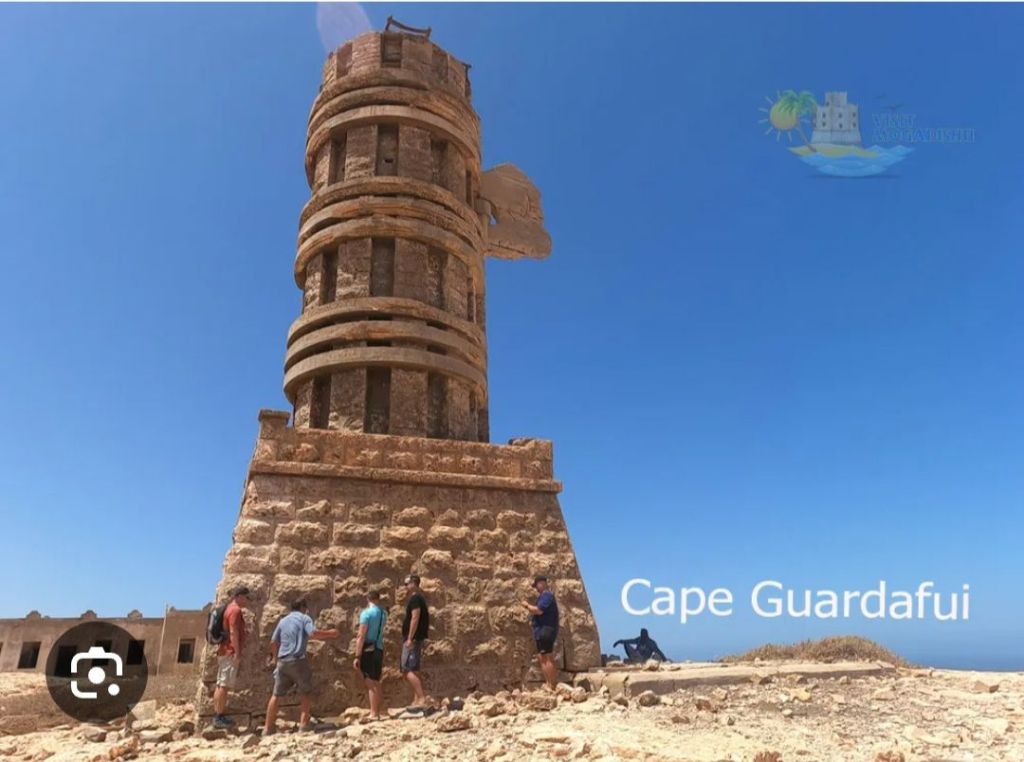
The Federal Member State of Puntland is strategically located at the tipmost of the Horn of Africa, where the waters of the Indian Ocean and the Red Sea mix in an spectacular fashion that amazes scientists and fishermen alike. Off the coastline of Ras Asayr (Cape Guardafui) within the territorial waters of Somalia is the marine navigation route of almost one-third of the international shipping world. Between the Cape and the Sea, there is a natural Suez Canal. Former Italian Colonial Administration of Somalia had built a lighthouse for navigation and used to collect levies from international shipping lines for using the guiding lighthouse. Without passing through this strait, ships could go around the Indian Ocean, spending millions of barrels of fuel and as many days to reach their various destinations of the globe. Nowadays, modern ships don’t need a lighthouse for navigation, but they need to pass through Cape Guardafui.
With this preliminary knowledge, the late vice-president of Puntland State, Mohamed Abdi Hashi, and myself as the Chief of Cabinet at the presidency decided to explore potential business opportunities of Cape Guardafui for navigation, tourism and collection of levies for Puntland Government. Our efforts led us to the study of the history of the Cape. We learned that most international shipping liners are insured by British Lloyd’s Insurance Marketplace Co. When there were security incidents in a particular marine route, Lloyd’s would raise the insurance premiums and change policy. We learned that the Italians in Somalia had been experiencing a problem in sustaining the operations at the Guardafui Lighthouse. That is because the operators of the lighthouse often disappeared. Ships without the guidance of the lighthouse could go astray those days to hit the rocks. Local fishermen used to take advantage of such shipwrecks. When that happens, goods recovered are reported first to the King of Majertainia. That is why we have the slogan, bad kasoo bah, Boqor baa leh, which roughly translates into: the King is sovereign over sea spoils. We also learned that shipping liners had spread false rumours that the local inhabitants in the Cape practised cannibalism and that is why operators of the lighthouse often disappeared. As a result, Lloyd’s insurance premiums skyrocketed on the route to Cape Guardafui. We found out that local people in the Cape persuaded the lighthouse operators to settle in and abandon the lighthouse so that ships could wreck off Cape Guardafui.
As we continued to work on our project, we sought international help. Some Swiss firms indicated business interest to build forwarding facilities such as supply of water, fuel, and explore tourist infrastructure for all year sunshine bath and indulgences in tropical fruits, fresh fish and lobsters. Tourist cruise ships could find it attractive to spend days at would-be tourist resorts of Cape Guardafui.
Finally, the US government warned Swiss firms that they couldn’t implement such a project for: 1. Puntland State was not a sovereign country. 2. Since there was no central government in Somalia, the US considered sea waters of Somalia as international. We suspended the continuation of the project to wait for another day for the next generation to realize it.
But, this is important to note: Successive administrations of Puntland State had never appreciated the strategic position of national and international importance the state can employ for its own advantages and leverage to be viable and potential independent country, in the place of its permanent quarrels with Mogadishu.
___________
If you enjoyed this story and would like to read more like it, consider supporting WDM work by subcribing to our Annual Subscription at +252 90 703 4081. Your support helps us to keep producing more content like this.
[This article has been updated after posting].
 Warsame Policy & Media Network (WAPMEN)
You must be logged in to post a comment.