THE SOMALI LAW OF THE SEA: AW NO. 37 OF 10 SEPTEMBER 1972 LAW ON THE SOMALI TERRITORIAL SEA AND PORTS

THE PRESIDENTOF THE SUPREME REVOLUTIONARY COUNCILHAVING SEEN The First Charter of the Revolution;CONSIDERING The approval of the Councils SRC and Secretaries of State;PROMULGATES the following Law:Article 1. The Territorial Sea. 1.The Somali Territorial Sea includes the portion of the Sea to the extent of 200 nautical miles within the continental and insular coasts, delimited according to the provisions of Articles 2 and 3 of this Law. 2. The Somali Territorial Sea is under the sovereignty of the Somali Democratic Republic. Offences committed within these limits of the territorial sea on board a vessel relating to penal health, and public security shall be governed by Somali Law.Article 2. Measurement of the Territorial Sea: 1. The normal base line for measuring the breadth of the territorial sea is the low water line along the coast. 2. In localities where the coastline is deeply indented or if there is a friings of islands along the coast in its immediate vicinity, the method of straight baseline joining appropriate points may be employed in drawing the baseline from which the breadth of the territorial Sea is measured. 3. Waters on the landward side of the baseline of the Territorial Sea form part of the internal waters of the State within the meaning of Article 4 below. Article 3.Territorial Sea for Islands and Archipelagos. 1 Where an island is situated within the 200 mile limit, the belt of waters round it will constitute territorial waters. This belt will be 200 miles wide and will be measured from low-water mark following the sinuasities of the island.2. A group of islands forming part of an archipelago shall be considered as a unit, and its territorial waters shall be measured from the centre of the archipelago. Article 4. Internal Waters and Maritime Ports. 1. The internal maritime waters include all navigable waters in Somali rivers open for maritime vessels and maritime ports with the areas as delimited by the table annexed herewith.2 The internal Somali waters are subject to the sovereignty of the Republic according to Somali Laws and the provision of this Law.Article 5Fishing and Coastal Navigation1 Fishing in the territorial sea and regular transportation of persons and goods between Somali Ports are reserved for vessels flying the Somali Flag and other authorised vessels.2. Any infringement of the above provision shall be punished with a fine from 5,000/- to 100,000/-So. Shs. and in case of repetition of the infringement by the vessel or the operator, the punishment may be doubled and the captain shall be liable for offences prescribed by the Somali Penal Laws and the vessel may be confiscated.3. Any contract of transportation made in violation of paragraph 1 above is void and without effect and the vessel executing or intending to execute the contract shall be subject to a fine equal to 5 times the freight or the fare stipulated or fixed by the usage for similar operation.Article 6Innocent Passage Through the Territorial SeaSubject to the provisions of the Law merchant ships of all nationalities are allowed to the right of innocent passage through the Territorial Sea within the limits laid down by this Law and the general principles of the international Law of the Sea.Article 7Meaning of Innocent Passage1. Passage means navigation through the Territorial Sea for the purpose of either traversing that sea without entering internal waters or of proceeding to internal waters or of making for the high Sea from internal waters.2 Passage includes stopping and anchoring, but only in so far as the same are incidental to ordinary navigation or are rendered necessary by force majeur or by distress, but not for loading or unloading goods for passengers.Article 8Limits of Innocent PassagePassage is innocent so long as it is not prejudicial to peace, good order, health or security of the Republic. Such passage shall take place in conformity with the provisions of this Law, and with the general rules and principles of international Law.Article 9 Prohibited Passage1. Passage in the Territorial Sea and internal waters is not allowed to vessels having the nationality of states not recognised by the Somali Democratic Republic.2. In case of violation of the above paragraph, the Somali authorities may take any measures necessary to ensure its.Article 10Warships1. Foreign Warships are not allowed to passage through the Territorial Sea unless they are authorised by the Somali Government.Article 11Respect of Somali Laws in Territorial Sea1 All ships exercising the right of innocent passage shall comply with Somali Laws and regulations.2. Each vessel, while passing through the Territorial Sea, shall hoist its national flag and comply with the orders made according to Somali Laws – by the competent Authorities.3. In case of infringement of any of the two above paragraphs, the vessel shall be punished with a fine from 1,000/ to 100,000/- So. Shs. unless the fact or the omission constitutes a more grave crime.Article 12Entering to Internal Waters1. All Ships proceeding to internal waters or ports shall comply with the provisions set by the maritime Code for this purpose.2. Subject to the limitation laid down by Article 5 of this Law all mercant ships except those mentioned by Article 9 paragraph 1 above are granted the rights to enter in Somali Ports for any commercial operation, especially to load, unloade, unload cargoes, embark or disembark passengers. Article 13Defence ZonesThe Somali competent Authorities may take the necessary measures to suspend temporarily innocent passage of all foreign ships, in specified areas of the territorial sea, if this becomes necessary for the protection of the security of the State. Article 14Charges for Services RenderedCharges levied on Ships in internal waters are also levied upon foreign Ships passing through the Territorial sea for services rendered or measures taken regarding the vessels for their security and the implementation of rules of the police of the navigation.Article 15Criminal Jurisdiction on Foreign Ships1. The criminal jurisdiction of the Republic shall be exercised on board foreign ships passing through the Territorial sea or anchoring in the ports with respect to the arrest of any person or conduct any investigation in connection with any crime committed on board the ship during its passage. Criminal jurisdiction is confirmed to the following cases:(a) if the consequences of the crime extend to the Territory of the Republic;(b) if the crime is of a kind to disturb the peace of the country or the order of the Territorial Sea or the Port;(c) if the assistance of the local authorities has been requested by the captain of the Ship or by the Consul of the country whose flag the Ship flies;(d) if it is necessary for the suspension of illicit traffic in narcotic drugs.2. The Authorities may take any step authorised by the Somali Laws and regulations for the purpose of any arrest or investigation on board a foreign ship while it is passing through the Territorial Sea after leaving the internal waters or the port.3. In the cases provided for in paragraph 1 and 2 of this Article the Authorities shall, if the captain so requests, advise the consular Authority of the Flag State before taking any steps, and shall facilitate contact between such Authorities and the ship’s crew. In cases of emergency, this notification may be communicated while the measures are being taken.4. Local Authorities shall not take any steps on board a ship passing through the Territorial Sea to arrest any person or conduct any investigation in connection with any crime committed before the ship enters into the Territorial Sea and it is only passing through the Territorial Sea without entering internal waters.Article 16 Civil Jurisdiction on Foreign ShipsThe authorities may not levy execution against, or arrest, the ship for the purpose of any civil proceeding, save only:(a) in respect of obligations or liabilities assumed or incurred by the ship itself in the course or for the purpose of its voyage through the Territorial Sea or internal waters; (b) in the cases provided for by the maritime Code.Article 17 Government Ships1. The rules provided for in the preceding Article shall apply also to foreign government ships operated for commercial purposes.2. The above rules do not affect the immunities which Government ships operated for non commercial purposes enjoy.Article 18Arrest Vessels by the AuthoritiesIn case where a punishment is prescribed for infringement committed by a foreign vessel the Somali Authorities may arrest the vessel until the said punishment is fulfilled or a sufficient security for this purpose is furnished.Article 19Any provision contrary to this Law or inconsistent with it is hereby abrogated.Article 20Entry into Force of this LawThis Law shall come into force on the thirtieth day of its publication.Mogadishu, 10 September 1972.

THE PRESIDENT of the Supreme Revolutionary Council Major Gen. Mohamed Siyad Barre
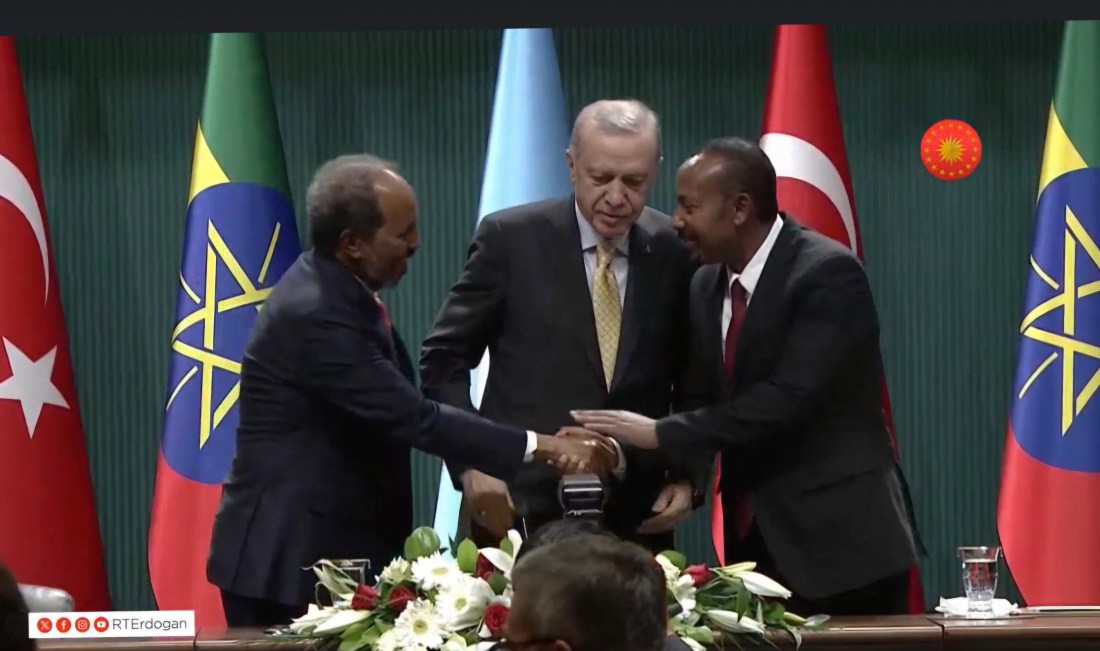
Brief Expert Analysis of the Ethiopia-Somalia Ankara Declaration (11 December 2024)

By AA,Expert in LLM,December 12, 2024.

Ethiopia presented clear and focused demands during its recent negotiations with Somalia, mediated by Turkey in Ankara, while Somalia’s position remained broad and ambitious. Ethiopia’s objectives were explicitly outlined in the communiqué, reflecting its strategic priorities.Ethiopia’s Demands:1. Recognition of Ethiopia’s Military Role in Somalia:The FGS’s decision to exclude Ethiopia from the Troops Contributing Countries in the new mission (AUSSOM) and its push for Ethiopia’s withdrawal from Somali territory, while condemning certain military maneuvers in parts of the country, appeared to downplay Ethiopia’s role and neutrality in Somalia. As a result, Ethiopia sought to leverage the communiqué to prompt Somalia into acknowledging of its military influence and strategic leverage over the country, positioning this as a basis for its involvement in the new mission.The communiqué emphasizes the significance of the point in a standalone line, stating:“Somalia recognizes the sacrifices of Ethiopian soldiers within the African Union Missions.”Notably, it does not specifically refer to ATMIS or AMISOM, but rather uses the term “African Union Missions” to encompass both past and potential missions.2. Access to the Somali Sea:Ethiopia emphasized the need for assured and secure access to the Somali sea, framing this as a strategic priority. The communiqué included the following language:“They acknowledged the potentially diverse benefits that could be derived from Ethiopia’s assured access to and from the sea.”It further elaborated:“They agreed to closely work together to finalize mutually advantageous commercial arrangements through bilateral agreements, including contract, lease, and similar modalities, which will allow the Federal Democratic Republic of Ethiopia to enjoy reliable, secure, and sustainable access to and from the sea.”3. Expeditious Technical Arrangements on Sea Access:Ethiopia sought to expedite technical negotiations with the Federal Government of Somalia (FGS) to formalize the sea access agreement. This urgency was underscored by its intention to secure agreements with Somalia before revising its arrangements with Somaliland. The communiqué stated:“They decided to start technical negotiations in good faith for these purposes no later than the end of February 2025, with the facilitation of Türkiye, to be concluded and signed in four months.”Somalia’s Position:1. Ethiopia’s Withdrawal from the MoU with Somaliland:Somalia long sought Ethiopia’s explicit retraction of its Memorandum of Understanding (MoU) with Somaliland, which Somalia considers illegal. However, the communiqué made no direct reference to this demand. Instead, it adopted broad and general language, stating:“They agreed, within a spirit of friendship and mutual respect, to forgo and leave behind differences and contentious issues and collaborate in a cooperative manner to pursue shared prosperity.”Ethiopia deliberately refrained to explicitly express cancelling the MoU with Somaliland, likely to serve as plausible deniability in case of any future uncertainties with Somalia, and to avoid a direct confrontation with Somaliland. On the other hand, Somalia critically failed to unequivocally assert this vital position, which lies at the heart of the communiqué and represents the primary source of conflict between the two countries.2. Reaffirmation of Somaliland’s Status as Part of Somalia:Somalia also wanted Ethiopia to explicitly reaffirm that Somaliland remains an indisputable part of Somalia This position stemmed from Ethiopia’s actions, which implied recognition of Somaliland as a sovereign state (Tacit Recognition). Under international law, a state’s actions and statements on such matters carry legal implications and contribute to establishing its official stance. However, the communiqué did not directly address this issue. Instead, it used broad language regarding the relationship between the two nations:“The Leaders of Somalia and Ethiopia reaffirmed their respect and commitment to one another’s sovereignty, unity, independence, and territorial integrity, as well as the principles enshrined in international law, the Charter of the United Nations, and the Constitutive Act of the African Union.”This indicates that Ethiopia deliberately avoided any explicit mention of Somaliland, while Somalia failed to effectively articulate this point, instead relying on general language in the communiqué.Conclusions:1. Ethiopia was precise and strategic in articulating its demands within the communiqué, whereas Somalia’s position was broader and lacked specificity, particularly regarding critical sovereignty issues.2. Ethiopia’s inclusion of terms such as “assured access,” “reliable, secure, and sustainable access” reflects its long-term strategic interests. These terms could significantly influence future negotiations with Somalia, particularly concerning maritime access and sovereignty.3. Somalia needs to be more strategic and articulate in the upcoming technical discussions, ensuring that potential agreements with Ethiopia align with the Somalis commercial interests.

[Courtesy].

REPORTS ON ETHIO-SOMALIA DEAL IN ANKARA

“When Somali President Hassan Sheikh Mohamud and Ethiopian Prime Minister Abiy Ahmed met in Ankara on Wednesday, expectations from their Turkish hosts were high.

The Turkish government had been attempting to mediate the sea port crisis between the two countries for almost a year through two rounds of negotiations, but no tangible progress had been made beyond vague statements of goodwill.

Mogadishu has been demanding that Ethiopia cancel a memorandum of understanding (MoU) it signed with Somalia’s breakaway northern region of Somaliland in January. This agreement aimed to grant Ethiopia port access through Somaliland’s coastline for the next 50 years.

Somalia viewed the MoU as a potential recognition of Somaliland as a sovereign state and threatened war to protect its territorial integrity. Ethiopia, in contrast, argued that as a landlocked country, it had a right to sea access under international law.

“You won’t leave this room until you reach a deal,” Turkish President Recep Tayyip Erdogan said during the negotiations, according to a person familiar with the issue speaking to Middle East Eye.

When Somali President Hassan Sheikh Mohamud and Ethiopian Prime Minister Abiy Ahmed met in Ankara on Wednesday, expectations from their Turkish hosts were high.

The Turkish government had been attempting to mediate the sea port crisis between the two countries for almost a year through two rounds of negotiations, but no tangible progress had been made beyond vague statements of goodwill.

Mogadishu has been demanding that Ethiopia cancel a memorandum of understanding (MoU) it signed with Somalia’s breakaway northern region of Somaliland in January. This agreement aimed to grant Ethiopia port access through Somaliland’s coastline for the next 50 years.

Somalia viewed the MoU as a potential recognition of Somaliland as a sovereign state and threatened war to protect its territorial integrity. Ethiopia, in contrast, argued that as a landlocked country, it had a right to sea access under international law.

“You won’t leave this room until you reach a deal,” Turkish President Recep Tayyip Erdogan said during the negotiations, according to a person familiar with the issue speaking to Middle East Eye.

Jerusalem Dispatch
Erdogan, who has known both leaders for years, has invested heavily in Somalia since 2011. Turkey has established a military base in the country, trained thousands of Somali soldiers, managed Mogadishu’s airport and port, and provided extensive humanitarian and military aid.

In 2021, Erdogan’s decision to sell Turkish armed drones to Abiy tipped the balance of Ethiopia’s civil war against the Tigray forces in Abiy’s favour.

Sticking point
A Turkish official stated that the negotiations between the two leaders and their respective teams lasted nearly seven uninterrupted hours, with Erdogan and Turkish Foreign Minister Hakan Fidan actively participating.

According to a source familiar with the talks, one of the key sticking points was Ethiopia’s recognition of Somalia’s territorial unity. This recognition would effectively require Ethiopia to cancel its MoU with Somaliland.

The source added that while Abiy was willing to sign a statement committing to Somalia’s independence and sovereignty, he resisted any mention of “territorial integrity” or “unity”.

The Somali delegation countered by referencing the 1933 Montevideo Convention, which codifies international legal norms and principles regarding statehood. One of its key criteria for statehood is the possession of a “defined territory”.

“You cannot say you recognise a country but deny that it has a defined territory,” the source explained.

Turkish officials found this argument persuasive, concluding that Ethiopia must either recognise Somalia in its entirety under international law or not at all.

Hours of negotiations later, Somalia and Ethiopia finally reached a final agreement, known as the Ankara Declaration, that addressed the core demands of both. Somalia secured Ethiopia’s recognition of its territorial unity, while Ethiopia was granted commercial access to the Somali coastline.

The declaration also stipulated that technical delegations from both nations, facilitated by Turkey, would begin negotiations no later than February 2025, with a deadline to complete the talks within four months. Turkish officials hailed the deal as a victory for both sides.

the incoming Donald Trump administration is already considering recognising the breakaway state.

Some analysts argue that Abiy achieved his primary objective, as he has long sought to address Ethiopia’s landlocked status. By triggering the crisis, he forced the issue to the forefront and secured a deal granting Ethiopia access to the Somali coast.

“It’s a sort of win-win agreement,” said Omar Mahmood, a senior analyst for Eastern Africa at Crisis Group. “This deal still provides Abiy Ahmed with access to the sea, and it makes sense for the Ethiopian market to be connected to the Somali coast.”

EYL/ BADDEY/INDIAN OCEAN VIEWS AND VIDEOS

The Smart Way to Keep People Passive and Obedient: Insights from Noam Chomsky

Noam Chomsky, one of the most influential intellectuals of the 20th century, has spent decades examining the dynamics of power, control, and media manipulation. In his book How the World Works, Chomsky provides a thought-provoking analysis of how societies are shaped by the limits imposed on acceptable discourse. One of his most powerful observations is encapsulated in the quote: “The smart way to keep people passive and obedient is to strictly limit the spectrum of acceptable opinion, but allow very lively debate within that spectrum. That gives people the sense that there’s free thinking going on, while all the time the presuppositions of the system are being reinforced by the limits put on the range of the debate.”

This concept is a cornerstone of Chomsky’s critique of modern media and its role in shaping public perception and maintaining societal order. Let’s delve into the deeper meaning behind this statement and explore its implications.

The Illusion of Free Thinking

Chomsky argues that by allowing a narrow range of opinions to be expressed while encouraging spirited debate within that range, those in power create an illusion of freedom and democracy. The debate may be heated, passionate, and seemingly unconstrained, but it never steps outside the bounds of what the system deems acceptable. This creates a situation where people feel they are participating in a free exchange of ideas, even as the underlying assumptions and power structures remain unchallenged.

For example, in the realm of mainstream politics, there might be fierce debates over specific policies or candidates, but the fundamental structures of economic and political power are rarely questioned. The media plays a crucial role in this process by framing the debate, selecting which voices are amplified, and which issues are deemed worthy of discussion. As a result, the public is kept within a mental framework that reinforces the status quo.

The Role of Media in Shaping Opinion

Chomsky’s observation draws attention to the subtle ways in which media can be used as a tool of control. By limiting the spectrum of acceptable opinion, the media ensures that certain ideas are never brought to light, while others are constantly reinforced. This is not necessarily through overt censorship, but through the more insidious process of agenda-setting and framing. The media decides which topics are worthy of discussion, which perspectives are given airtime, and which are marginalized or ignored altogether.

This process helps to maintain the power structures within society. For instance, economic debates often focus on how to manage capitalism rather than questioning the system itself. By restricting the debate to such issues, the media and those in power prevent alternative economic systems from gaining traction. The same can be said for debates on foreign policy, social issues, and other critical areas where the spectrum of acceptable opinion is carefully managed.

The Limits of Debate

Chomsky’s insight also raises important questions about the nature of debate and discourse in modern society. If the boundaries of debate are set by those in power, how can true change ever occur? Chomsky suggests that real change requires expanding the spectrum of acceptable opinion, questioning the assumptions that underpin the current system, and allowing for a truly free exchange of ideas.

This can be a daunting task, especially in a society where the media, education system, and other institutions are often complicit in maintaining the status quo. However, Chomsky’s work encourages us to be vigilant, to question the limits imposed on our thinking, and to seek out alternative perspectives that challenge the dominant narrative.

Conclusion

Noam Chomsky’s observation about the smart way to keep people passive and obedient is a powerful reminder of the importance of critical thinking and media literacy. By recognizing the ways in which debate is constrained and opinions are shaped, we can begin to challenge the assumptions that underlie our society and work towards a more open and inclusive discourse. In a world where the spectrum of acceptable opinion is often narrowly defined, it is up to us to push those boundaries, question the status quo, and seek out the truth.

For those interested in exploring these ideas further, Chomsky’s book How the World Works is an essential read, offering a deeper understanding of the forces that shape our world.

For Readers:

Do you think the boundaries of acceptable opinion in our society are limiting true progress, and how can we push beyond them to foster meaningful change?

[Courtesy].